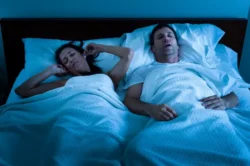
Snoring is often treated as a joke. The punchline of late-night TV commercials. A gentle elbow in the ribs from a frustrated partner. But for millions of people, snoring isn’t funny. It can be the first sign of something more serious: obstructive sleep apnea.
A dentist could help with that. Not just with a mouthguard you buy at the drugstore, but with a custom-fitted oral appliance that can literally change how well you sleep. At East Hills Dental Associates in Roslyn Heights, we offer oral appliance therapy for patients who snore or have been diagnosed with mild to moderate sleep apnea.
What Is Sleep Apnea and Why Does It Matter?
Sleep apnea happens when the airway collapses or becomes blocked during sleep. The person stops breathing, sometimes dozens or hundreds of times per night. Their brain wakes them up just enough to start breathing again, but not enough to remember it happening.
The result? Exhaustion. Morning headaches. Brain fog. And over time, a higher risk of high blood pressure, heart disease, and stroke.
The most common treatment is a CPAP machine, which pushes air through a mask to keep the airway open. CPAP works very well. But it also works only if people actually use it. And a lot of people don’t. The mask feels claustrophobic. The machine is noisy. Traveling with it is a hassle. That’s where a dental sleep appliance comes in.
How Oral Appliance Therapy Works
An oral appliance for sleep apnea looks a bit like a sports mouthguard, but more refined. It fits over the upper and lower teeth and gently holds the lower jaw forward. That small movement keeps the airway open during sleep.
We custom-fit every appliance right here in our office. No one-size-fits-all devices from the internet. We take impressions, adjust for comfort, and make sure the appliance holds the jaw in exactly the right position. Too far forward and the jaw gets sore. Too far back and it does not work. The right fit makes all the difference.
Patients wear the appliance only while sleeping. It’s small, quiet, and portable. No electricity required. No mask. And no noise.
Who’s a Good Candidate?
Oral appliance therapy is not for everyone. For patients with severe sleep apnea, a CPAP is still the gold standard. But for people with mild to moderate sleep apnea, or for those who simply cannot tolerate CPAP, an oral appliance can be life-changing.
The first step is a proper diagnosis. We do not guess at sleep apnea. We work with sleep physicians who can order a sleep study. Once a diagnosis is confirmed, we can determine whether an oral appliance is the right solution.
For patients who snore loudly but don’t have sleep apnea, an appliance could also help. Sometimes the snoring itself is the problem, for the person sleeping next to you. A quiet night of sleep is not a luxury. It’s a basic need for both people in the bed.
What to Expect
Getting an oral appliance takes two to three visits. First, we evaluate the jaw and take impressions. Second, we fit the appliance and make adjustments. Third, we fine-tune everything and send the patient home with instructions.
Most patients adapt within a few nights. The most common complaint is mild jaw soreness in the morning, which usually goes away as the muscles adjust. Follow-up visits ensure everything is working as it should.
Better Sleep Changes Everything
We have seen patients come back after using an oral appliance and tell us they feel like different people. More energy. Better focus. No more falling asleep at their desk or while watching TV. Their partners are sleeping better too.
If snoring or exhaustion has become normal in your home, it does not have to stay that way. Give us a call at East Hills Dental Associates in Roslyn Heights. We can talk about whether oral appliance therapy might help you finally get a good night’s sleep.